


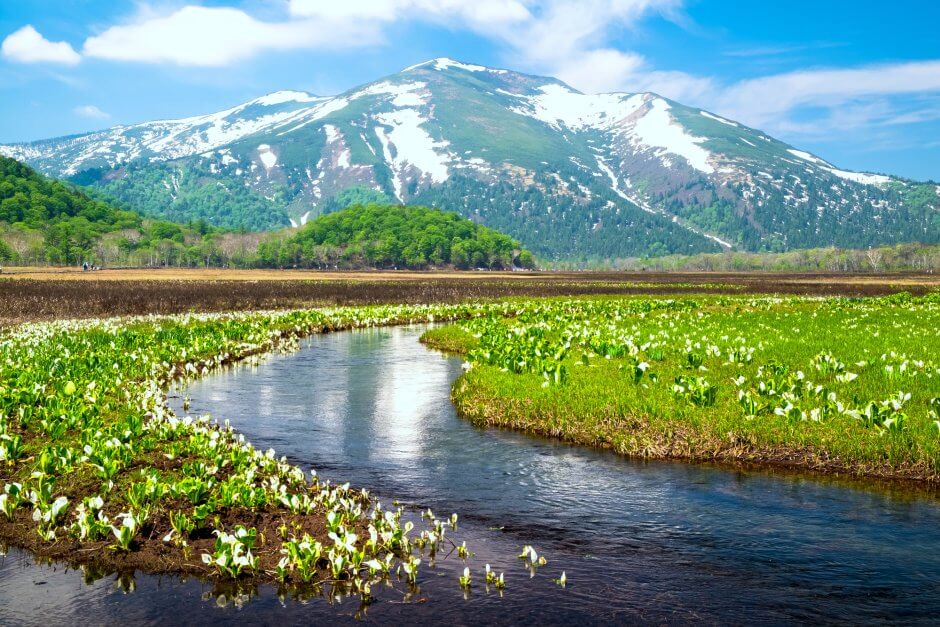
Oze is famous for the white skunk cabbage that flowers as the snow melts. Even lovelier than the flowers, though, is the way the mountains and forests change colour with the seasons. In May, everything is still under snow. In June, fresh green leaves unfurl among the lingering snow, and the mountains change colour by the day. By mid-September the marsh grasses are a sweep of autumn colour; the trees begin to turn in early October. Come in early summer or autumn for a stroll, or in summer to climb the peaks. To see the skunk cabbage in flower, come between late May and mid-June. Don’t let the title of the Japanese song ‘Natsu no Omoide’ (‘Memories of Summer’) mislead you: the Oze it celebrates is Oze in early summer.
Getting to ‘faraway Oze’
Oze National Park, which straddles the borders of Niigata and its neighbouring prefectures, is one of Japan’s great headwater regions. The Uonuma–Oze Route approaches from Niigata, following the Tadami River towards its source from Lake Okutadami, where Oze Jujo stands on the shore.
It isn’t as convenient as coming from Gunma via Hatomachi Pass, or via Oshimizu and Sanpei Pass. But because it follows the river upstream, you might call the Uonuma–Oze Route the ‘proper’ way into Oze. We hope you’ll enjoy the journey to ‘faraway Oze’: first take in the views from a sightseeing boat on Lake Okutadami (also called Lake Ginzan), much loved by the writer Takeshi Kaiko, then take the connecting bus through old-growth forest.
The Lake Okutadami sightseeing boat and connecting bus make just two return trips a day, one in the morning and one in the evening. So if you want to get there and back in a day, there’s only one departure you can take. Book at least three days ahead; if seats are still available, you can book up to the day before. Once you know your dates, it’s best to reserve early.
By car, it takes about 70 minutes to follow the lakeshore from Oze Jujo to Oze Miike. The road is surfaced but narrow, with plenty of bends, so it’s best suited to confident drivers. Private cars aren’t allowed beyond Oze Miike. From there, buses leave every 30 minutes for Numayama Pass; the ride takes 20 minutes.
The boat and bus on the Uonuma–Oze Route usually run from early June to mid-October, and the bus from Oze Miike to Numayama Pass runs until the end of October. From November onwards, it’s a lovely time to see clouds spilling like a waterfall over Shiori Pass, near Oze Jujo. It’s also a wonderful season for a sauna, so take the opportunity to enjoy the countryside around Oze Jujo.
Bookings for the Uonuma–Oze Route
Uonuma City Tourism Association: 025-792-7300
https://www.iine-uonuma.jp/activity/climbing/oze/oze06/
A day trip for beginners
Oe Marsh and Lake Ozenuma: two places in Oze where the flowers are especially plentiful
Oze’s two best-known sights are Ozegahara Marsh and Lake Ozenuma. Of the two, the lake is easier to reach on the Uonuma–Oze Route. Even at a leisurely pace, it’s only a little over an hour’s walk from Numayama Pass, with very little climbing or descending.
From the bus stop, a gentle climb of about 25 minutes brings you to a viewpoint. From there it’s downhill for about ten minutes to Oe Marsh, known for its profusion of flowers. Then it’s a half-hour stroll along an almost level boardwalk, and before you know it you’re at Lake Ozenuma. The handsome, old-fashioned Chozo Hut stands on the lakeshore. Its lamplit annexe serves pizza and Napolitan, a Japanese spaghetti dish with a ketchup-based sauce, as well as cake and coffee. Almost the entire walk is on boardwalks, with no hazardous sections.
[Diagram to be inserted here.]
What should I wear on my feet and for the weather?
• Any clothes you can move freely in will do. Bring waterproofs in case it rains. A folding umbrella will do, but waterproofs will also help keep you warm in a strong wind. In spring and autumn it can be quite cold, so a warm layer such as a fleece is essential too.
• Low-cut trainers are fine, but morning dew or rain can make the boardwalks very slippery. Choose shoes with a good grip.
• At your destination on the eastern shore of Lake Ozenuma, the mountain huts run cafés and shops, but they sometimes close at short notice. Always carry some water and food for the walk.
• There’s a charge for all toilets: please contribute at least ¥100 per visit. Bring several ¥100 coins.
One night in a mountain hut: for reasonably fit beginners
A mostly level walk along boardwalks: Lake Ozenuma, Ozegahara and Sanjo Falls
If you’re thinking, ‘We’ve come this far – let’s see Ozegahara as well as the lake’, carry on from Lake Ozenuma to Miharashi in Ozegahara on your first day. The standard walking time from the lake is two hours and 40 minutes; even if you stop by the lake for lunch, you can reach Miharashi by 16:00. There are plenty of mountain huts here, each with its own character. One look at Yashiro Hut and you might think you’ve stepped back in time. Sit down to eat at Oze Hut and you might find yourself asking, ‘Food like this in a mountain hut?’
The huts here are of a remarkably high standard. Most offer private rooms for parties of two or more. The huts have baths and flush toilets, too. Walk another half-hour or so and stay at Onsen Hut, and you can even enjoy a hot-spring bath.
The next day, explore Ozegahara and then walk on to Sanjo Falls: you get to see the lake, the marsh and the falls in one trip. From the falls, rather than going back to Numayama Pass, take the Ura-Hiuchi forest trail down to Oze Miike.
Most of the route is on boardwalks, but from Onsen Hut to the area around Sanjo Falls you’re on a mountain path. Parts of the boardwalk near the falls viewpoint and on the Ura-Hiuchi forest trail are beginning to give way. That said, the route is signposted throughout and there are no hazardous sections.
There’s very little up and down, but you’ll spend a fair while on your feet, so you’ll need a bit of stamina. If you run every day or spend your working days walking from client to client, you should manage it without any trouble.
[Diagram to be inserted here.]
What should I wear on my feet and for the weather?
• On a long walk, the main thing to watch for is a sudden change in the weather. In the mountains it’s quite common to set out in sunshine and find yourself in rain by early afternoon. Even in summer, hypothermia can be fatal in poor conditions. Wear a top and bottoms in quick-drying technical fabric or insulating merino wool designed for hiking, and carry waterproofs to keep out wind and rain. A change of clothes for the hut is essential in case you get wet, as is a warm layer such as a fleece: mornings and evenings can be decidedly cold.
• Many walkers rely on a rucksack cover alone, but it won’t keep out prolonged rain. Before packing, put your change of clothes for the hut (which can double as nightwear), towel and toiletries in a waterproof bag. Two bin bags, one inside the other, will also do.
• High-cut walking boots are fine, but hours on boardwalks can be surprisingly hard on the feet. We recommend low-cut running shoes with flexible, well-cushioned soles, provided they have a good grip and are waterproof, for instance with a Gore-Tex lining. Trail-running shoes with a waterproof, breathable membrane are ideal.
• On day one, the shop at Chozo Hut on Lake Ozenuma’s eastern shore and the Numajiri rest stop are convenient stops for water and toilets, with vending machines along the way. On day two there are no shops or toilets beyond Onsen Hut, so fill your water bottles and stock up on food for the walk at your hut in Miharashi.
• There’s a charge for all toilets: please contribute at least ¥100 per visit. Bring several ¥100 coins.
One night in a mountain hut: for very fit intermediate walkers
Take on Hiuchigatake, one of Japan’s 100 Famous Mountains!
If it isn’t a mountain holiday unless you’ve climbed a peak, try Hiuchigatake, one of the peaks on Japan’s ‘100 Famous Mountains’ list. The first day follows the beginners’ route above: from Numayama Pass, walk via Lake Ozenuma to Miharashi in Ozegahara. On day two, climb Hiuchigatake from Miharashi and descend to Oze Miike.
Day two is fairly demanding, so set off at 06:30. The path starts gently, grows steadily steeper and finishes with a very steep climb. Measured horizontally, it’s only 3.7 kilometres to the summit, Shibayasugura, but allow four hours and 20 minutes for the ascent. Even strong walkers take about three hours. It’s a long way down, too: the total walking time is seven hours and 20 minutes. On paper that’s much the same as the Ozegahara and Sanjo Falls walk, but it takes far more out of you. Choose this route if you’re confident of your stamina.
Walking shoes designed for mountain trails and proper mountain kit are essential on Hiuchigatake. Snowfields linger on the path until late June each year, so light crampons or chain spikes are a must. If you climb a little earlier, in skunk cabbage season, the steep snow slope on the descent from the summit towards Miike is extremely dangerous: you’ll need crampons and an ice axe. The paths are muddy not just during the thaw but well into summer. After rain they’re practically a bog, so we recommend gaiters.
[Diagram to be inserted here.]
What should I wear on my feet and for the weather?
• Take proper mountain kit. Hiuchigatake stands 2,356 metres high and, as an isolated peak, catches very strong winds. A sudden change in the weather can bring a violent storm. Hypothermia can be fatal even in summer, so warm clothing and waterproofs are essential.
• Even when the skunk cabbage is at its best in Ozegahara (late May to mid-June, depending on that year’s snowfall), there’s still snow on the paths up Hiuchigatake. Reaching the summit at Shibayasugura from Miharashi is only part of the challenge: the descent from Shibayasugura takes you down a snow slope of 50 degrees or more. Attempting the climb without crampons and an ice axe can lead to a serious accident. Come fully equipped so you can enjoy the climb.
• If you’re torn between low-cut shoes and high-cut boots, the rocky stretches, frequent mud and lingering snow make high-cut walking boots the best choice.
• Once you leave Miharashi, there are no toilets or shops until you reach Miike at the end of the descent.
Two nights in mountain huts: for fit, experienced walkers
Across Oze and over two of Japan’s 100 Famous Mountains: Hiuchigatake and Shibutsu
Take the evening service on the Uonuma–Oze Route to Miike and stay at Miike Lodge; there’s no hiking on the first day. On day two, climb Hiuchigatake, one of Japan’s 100 Famous Mountains, then descend to Ozegahara for the night. On day three, cross Ozegahara in the morning mist and climb another peak on the list, Mount Shibutsu. Descend to Hatomachi Pass and travel on by bus to Jomo-Kogen Station on the Joetsu Shinkansen high-speed rail line. This is the full Oze itinerary: 21.2 kilometres in two days of walking, with a total ascent of 1,790 metres and descent of 1,690 metres. It calls for stamina, but there are no particularly hazardous stretches and the walking is a pleasure.
The climb from Miike to Hiuchigatake gains 1,004 metres. There are fewer steep stretches than on the approach from Ozegahara, and at roughly hourly intervals you come to two marshes, first Hirosawatashiro, then Kumazawatashiro. They’re good places to pause, catch your breath and look at the flowers. The trade-off is a steep, rather demanding descent to Ozegahara on the Miharashi Shindo trail. Much of the second half is muddy: lose concentration for a moment and you can slip and end up covered in the stuff. Progress is slower than you might expect.
Still, Oze’s mountain huts have baths. Once you’ve had a soak and changed your clothes, even getting plastered in mud makes a good memory. At the eastern end of Ozegahara, Miharashi has plenty of huts where you can eat well, Oze Hut among them. Settle in over dinner and a glass of wine, ready for the next morning.
Ask the hut to pack you a bento (a boxed meal) instead of serving breakfast, and set out at dawn across misty Ozegahara. Not only is this the loveliest time to see the marsh, but outside skunk cabbage season you’ll have it almost to yourself. It’s just under two hours to Yamanohana, at the western end of the marsh, where the climb up Mount Shibutsu begins. Allow closer to three hours if you stop for photographs. Start climbing from Yamanohana by about 09:00 and you can reach the summit by noon and Hatomachi Pass by 14:00. From there, take a bus or shared taxi to Oze Tokura in time for the last bus to Jomo-Kogen at 15:12. Buses run roughly hourly, starting between 13:00 and 14:00. In summer, or whenever dawn comes early, bring the whole of day two’s itinerary forward. A hot-spring bath before boarding the bus – at Oze Burarikan, for instance, near the Tokura bus stop – makes a lovely finish.
What should I wear on my feet and for the weather?
• Take proper mountain kit. Both peaks are high: Hiuchigatake stands at 2,356 metres and Shibutsu at 2,228 metres. Even when there’s scarcely a breeze at Miike or in Ozegahara, strong winds can blow across the summits. Fierce afternoon thunderstorms are common in summer; if conditions turn against you, hypothermia can be fatal even then. Warm clothing and waterproofs are essential.
• Snow usually lingers on the paths up Hiuchigatake until late June. Immediately below Shibayasugura is a snow slope of 50 degrees or more. Carry crampons and an ice axe until early June, and light crampons or chain spikes after that until late June.
• With so much boardwalk to cover in Ozegahara, you may wonder whether to wear low-cut shoes or high-cut boots. From spring into summer, while snow lingers and there’s plenty of mud, go for high-cut boots. In autumn, mid- or low-cut footwear may suit you better, though even then the Miharashi Shindo trail turns to mud when it rains.
• On the route over Hiuchigatake there are no toilets or shops until your overnight stop at Miharashi. On the walk across Ozegahara, you’ll find toilets and can top up your water at Ryugu Hut along the way and at Yamanohana.
This information dates from the time of publication.