


Today marks two years since Satoyama Jujo opened. We owe that to every one of you who has supported us. Thank you so much.
Four years ago, a local farmer first told us about this place. ‘There’s an inn that’s closing down. Would you be interested?’ We wanted to find a new way to bring life back to a rural community, one that others could follow. We renovated the whole building and, two years ago today, opened our doors.
In the run-up to opening, I spent day after day worrying myself sick.
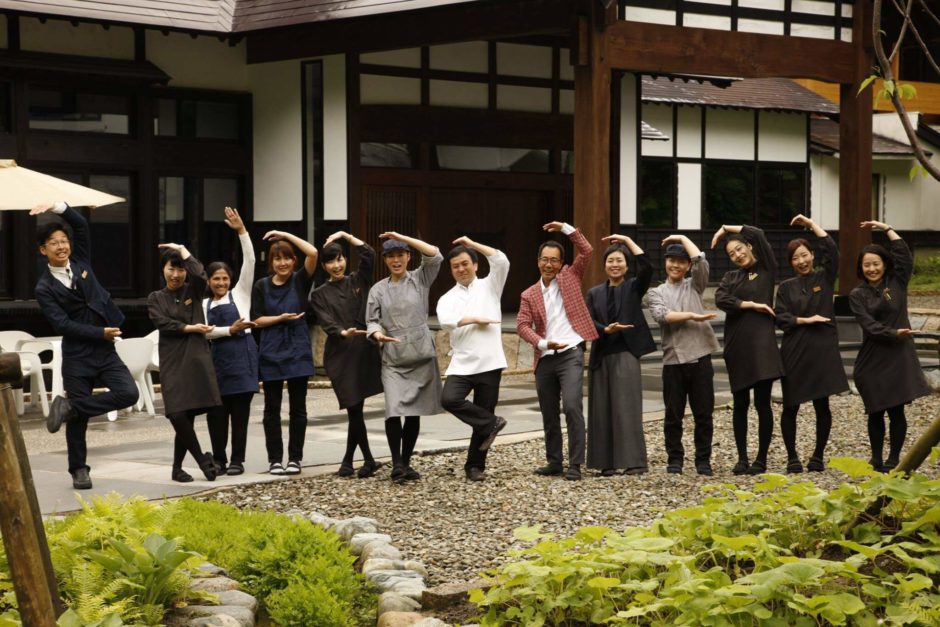
Partway through the building work, the bank told us it was withdrawing its loan and that the company would have to be wound up. ‘You’ll never achieve the spending per guest or the occupancy rate in this business plan in Niigata, least of all in Minamiuonuma. You’re spending far too much on the renovation. You’ll go under within six months.’ After that, it was extraordinarily difficult to raise money. We made it to opening day only because the local contractors stood by us, and because we believed in what Minamiuonuma, here in Niigata, had to offer and kept going. There’s plenty of talk about reviving Japan’s regions now, but when we came across this building, it was only a year since the Great East Japan Earthquake and the country was still at a very low ebb. Perhaps it’s no wonder the bank was so sure we would fail. Back then, no one was even talking about regional revival. My argument was that tourism would be vital to the future of rural Japan: it would sustain farming and, in turn, the wider community. People saw my point, but the answer was always, ‘That may be so, but we can’t help you financially.’ I was getting nowhere. Now, two years on, thanks to all of you, the bank’s prediction that we’d go under within six months has proved well wide of the mark. Average spending per guest has matched our projections, and occupancy has exceeded them. Even so, with only 12 guest rooms, Satoyama Jujo is barely breaking even. We still have a great deal to do to improve the generally poor pay and conditions in our industry (though I do think working conditions at Satoyama Jujo are far better than at most ryokan, Japan’s traditional inns). If we’re to bring down our average operating costs without raising prices, we’ll have to consider building a new wing. But that would simply mean taking on more debt. Investment in buildings and facilities in this business is written off over a long period, so we have to repay what we borrow over many years. However well things are going now, we’ll still need our guests’ support in ten or fifteen years’ time. Many local government officials and ryokan operators now come to Satoyama Jujo to see how we work. I think they come because they see a glimmer of hope here, both for the future of the ryokan business and for the revival of rural communities. For all the talk of regional revival, these are exceptionally difficult times to be running an inn or hotel in rural Japan. Spending per guest and occupancy are both falling, while staff costs are rising. Even owners who want to cut running costs find it hard to break with long-established practices. Then there’s the expense of maintaining facilities – banquet halls and lobbies, for instance – that are far too large for the number of guest rooms. Nearly all the ryokan long praised for looking after their guests at modest prices have been family businesses, kept going by the long hours the family put in. Medium-sized ryokan and hotels, too, have depended on the dedication of their staff. That way of working is now breaking down. The owner of one of those good-value inns will keep it going ‘as long as I live’, but that’s no basis for a lasting business. And when the inns decline, so does the region. Visitors from abroad are the one bright spot, yet very few places are actually reaping the rewards. One glance at the figures shows that the gap is set to widen. Cities such as Tokyo, Kyoto, Osaka and Sapporo, along with destinations such as Takayama and Hakone, will be in a still stronger position, while places that got off to a late start in attracting overseas visitors may well fall further behind. Perhaps, in the end, it will be only the big cities – Tokyo, Kyoto, Osaka – that see any real economic benefit from overseas tourism, with scarcely any reaching rural Japan. Satoyama Jujo isn’t about reviving a ryokan. What we set out to do was show how a region might be revived. For us at Jiyujin, it also brings together much of what we’ve worked on since we moved our publishing base from Tokyo to Niigata twelve years ago. We’ve been open for just two years. We’re still a long way from being able to call this a successful model. Even so, there’s plenty that simply can’t wait. Here at Satoyama Jujo we’ve found a way for rural communities to begin to turn things around. I’d like to share what we’ve learnt with people across Japan. And I want our own region, Uonuma in Niigata, to be thriving a hundred years from now! There’s still a long way to go (though I haven’t quite so many years left myself), and I mean to keep at it. I’m truly grateful to everyone who’s stood by us over these past two years. I hope you’ll continue to support us. Thank you! And in case you were wondering about the photo, that’s our second-anniversary pose.
Representative Director, Jiyujin Inc.
Creative Director, Satoyama Jujo
Toru Iwasa
*The information given here was current at the time of publication.