


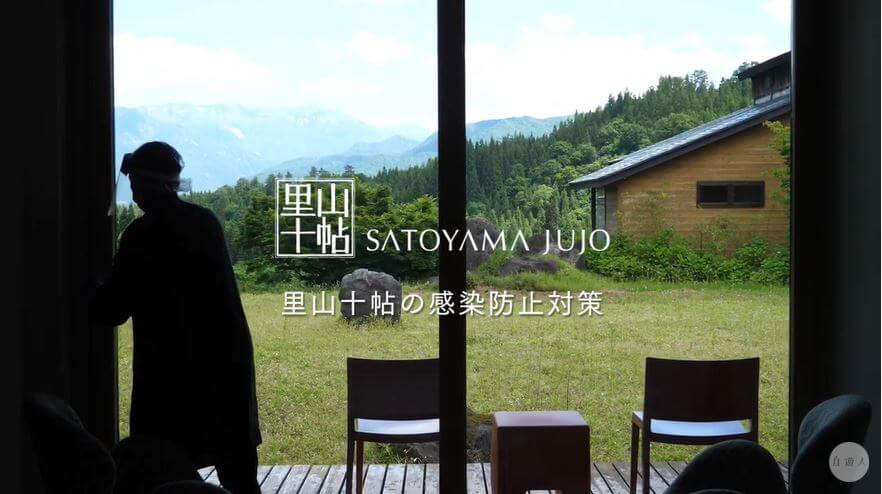
At Satoyama Jujo, we take every care to avoid the ‘three Cs’: closed spaces, crowded places and close-contact settings. We also update our precautions daily. We began this work in March and now have all six stages in place, refining them each day.
Stage 1: We clean and ventilate the premises thoroughly, use a range of methods for disinfection and sterilisation, and monitor our staff’s health, for instance by taking their temperatures. We take strict precautions to avoid the three Cs.
Stage 2: To protect the local community, we placed staff on leave if they lived with older people, were part of a large household, or worked part-time for us and also had a job elsewhere. We also placed staff on leave if they had a history of illness or an underlying health condition.
We are gradually lifting these restrictions. Applying the precautions in Stage 4 rigorously, alongside our other measures, has reduced the risk of staff catching an infection from a guest. Stage 3: We aim to avoid contact both between guests and staff and between guests themselves. Guests can opt to have breakfast and dinner in their rooms, and can also choose to check in there. We provide written information about the facilities and use the internal phones rather than explaining everything in person.
With precautions firmly in place on our side, we are returning to our usual way of looking after guests wherever possible. If you would rather avoid contact altogether, we also offer a ‘contact-free’ option: check-in and meals in your room, with no conversation or physical contact. We have brought back services we had suspended, including our bar service, by moving them outdoors. Stage 4: We realised that if a guest had an infection, the greatest risk to staff would come when cleaning that guest’s room. We therefore introduced strict precautions for housekeeping. Staff wear disposable gloves and hair covers, and use face shields when cleaning toilets. As their work clothes may come into contact with used linen or clothing guests have worn in their rooms, staff wear two layers. Both are washed daily and dried at a high temperature. To avoid carrying infection elsewhere, including into their own homes, staff change all their clothes, wash their hands and bathe after cleaning, among other precautions.
In place of isolation gowns, we use kappogi, traditional long-sleeved Japanese aprons, to keep used items from touching the clothing underneath. We wash both the aprons and the cleaning clothes worn beneath them every day. Stage 5: However many precautions we take, we cannot eliminate the risk. We believe mutual trust matters most in preventing infection. Our booking system requires guests to make the following pledge before they can complete a reservation:‘Can every guest in your party confirm on arrival that they have not been diagnosed with an infectious disease; that they have had no contact with anyone with an infectious disease in the two weeks before their stay; that they have avoided the three Cs as far as possible in daily life; and that they have had no cold symptoms in the days leading up to and including the day of arrival?’
If you answer ‘no’, we will ask why and, depending on the circumstances, may ask you not to visit. Because we ask for the pledge in advance, we do not ask you to have your temperature taken, fill in a health declaration or sign a pledge when you arrive. In practice, if we took your temperature on arrival and found you had a fever, it would be difficult to turn you away at that point. With the pledge taken care of in advance, we work each day to improve the way we look after you so that, once you are here, your stay can be as close to normal as possible. Stage 6: Rather than insist that everyone avoid contact to the same degree, we tailor our service to guests’ wishes while keeping precautions in place. When booking, guests must choose one of four answers to the following question:‘We take a number of precautions to protect both guests and staff from infection. The hardest thing to judge is how much distance you would like us to keep. How would you like us to look after you during your stay?
1. Please show me to my room without talking unless necessary. Please don’t touch my luggage, and please serve dinner and breakfast without conversation.
2. A brief explanation is fine, but please keep conversation to a minimum. I would still like you to carry my luggage.
3. I would like a moment to relax in the lobby at check-in, provided I can sit apart from other guests. Please keep explanations brief, including when telling me about the food.
4. Please look after me as you normally would, as far as possible. I would like to hear about the dishes in detail, provided you keep your distance while talking to me.’ Stages 5 and 6 in particular are our own initiatives. The idea is to base prevention on mutual trust rather than a single set of rules for everyone. At Satoyama Jujo, asking guests to make a pledge when booking helps reduce the likelihood of someone arriving with an infection. By also avoiding the three Cs and limiting contact both between guests and staff and between guests themselves, we do all we can to prevent infection. We have made a video to show you the work guests do not usually see, particularly how we clean. We hope you will take a look. Guests from the Tokyo metropolitan area are, of course, very welcome at Satoyama Jujo.
We look forward to welcoming you all. Jiyujin Inc.
Toru Iwasa, Representative Director https://www.youtube.com/watch?v=_0yzpr4Grbg
*This information was current at the time of publication.