


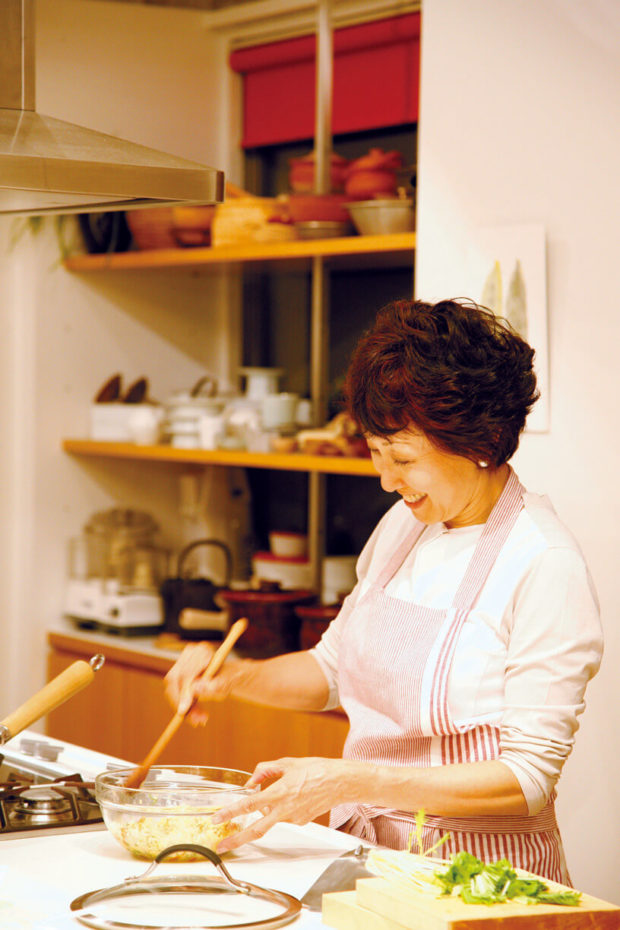
The hot springs are lovely, but for me the best thing is the food. Don’t worry! It really is wonderful. The food is perfect, right down to the choice of dishes it’s served in.
Michiko Matsuda, cookery teacher and writer
After graduating from Joshibi University of Art and Design, Matsuda studied under Fusako Holthaus. She learnt how to cook the home dishes of a number of countries before setting out on her own. She has run the Michiko Matsuda Cookery School since 1993 and written many books. Her latest are ‘Seasonings: Their Benefits and How to Cook with Them’ (Seibundo Shinkosha) and ‘Recipes for a Versatile Garlic Miso Marinade’ (Kawade Shobo Shinsha).
I first visited Satoyama Jujo in summer. Three days, two nights. My friends and I thought that if we were going away, it would be nice to have a purpose in mind, so we planned to practise the Japanese tea ceremony together. Everyone has their own reasons for travelling. We wanted a little peace somewhere different from our everyday surroundings, and the welcome we found at Satoyama Jujo put us at ease. There was one thing after another to be glad of. Little things, really, like being able to have a coffee in the lounge whenever we liked, or enjoy a drink there at our leisure in the evening. I liked the way those small kindnesses made it so easy to settle in.
At dinner, one dish came at a time, so we could savour each little portion. It wasn’t strictly kaiseki, the traditional Japanese meal served in a succession of courses. The use of Western ingredients, for instance, gave it a character of its own. I was touched, too, that they prepared an entirely different meal for us on our second evening.
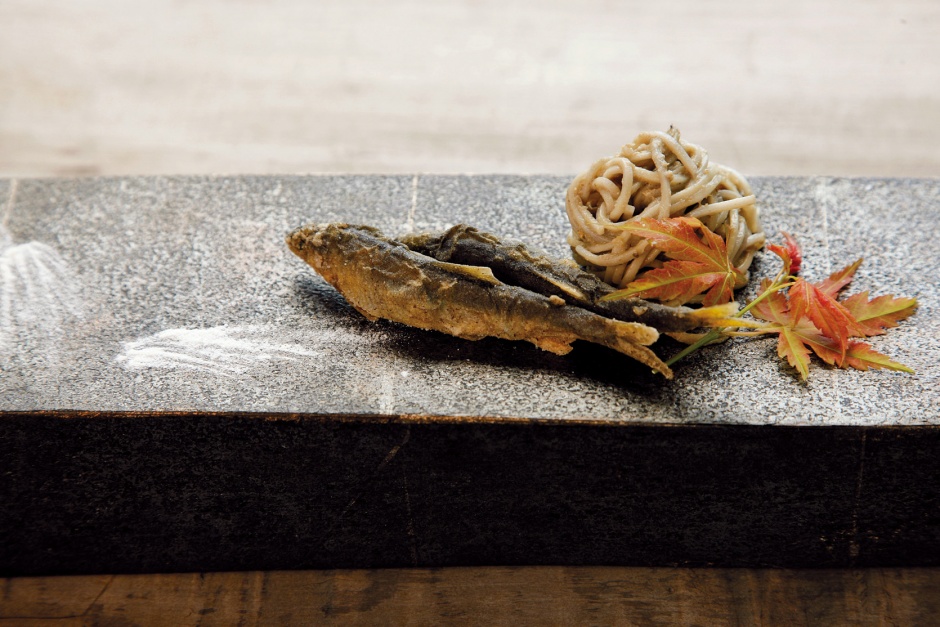
One dish that really stayed with me was the ‘ayu and hegi soba pasta’. I was told they’d put the ayu, or sweetfish, into a state of suspended animation before grilling it with salt and puréeing it whole. They paired it with hegi soba, a type of buckwheat noodle that’s a Niigata speciality. I couldn’t believe how good it was! I missed my chance this year, but next year I’d love to try making it myself.
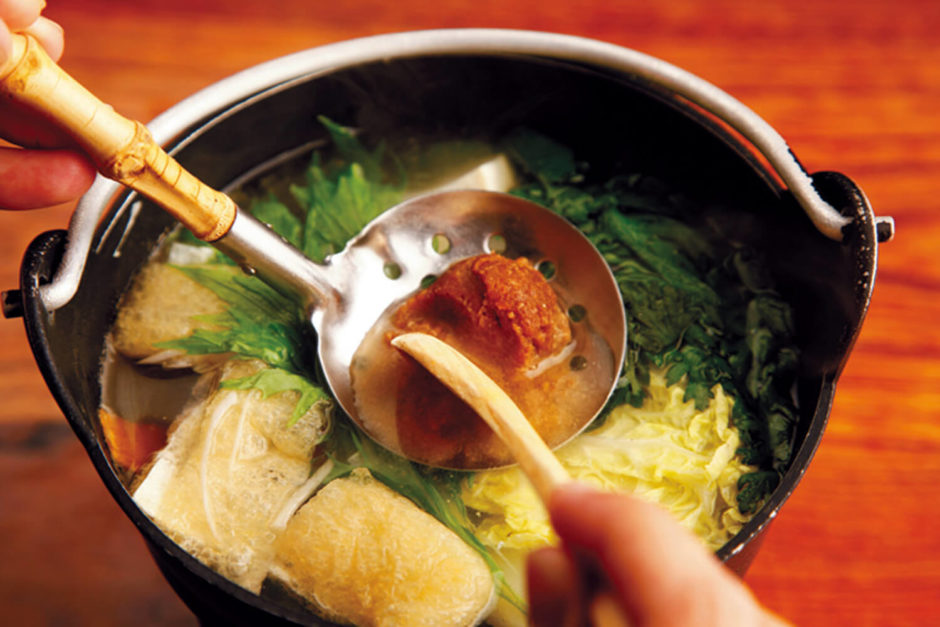
Then there was the miso soup at breakfast. I won’t forget that either. There were all sorts of things to put in it, with the miso paste and the dashi stock each set out separately, so you could take your time and make the soup just the way you liked it. In went the deep-fried tofu first, to let it soak up the stock, then the vegetables… If the Koshihikari rice grown in Minamiuonuma was the main dish at dinner, that miso soup was the main dish at breakfast. ‘It’s not often we finish all the miso soup at an inn, is it?’ we said, laughing as we tipped the pot to share the very last drop.
Come to think of it, just having the time to linger over breakfast with friends is a joy in itself. It makes me smile how often friends ask, ‘I know the open-air baths are lovely, but what’s the food like?’ I can tell them without hesitation, ‘Don’t worry. It’s wonderful!’ I love the way they use old and new tableware together, too. Right down to details like that, I think the food is perfect.
There’s a growing movement now to eat more regional produce and seek out the good things we’ve yet to discover, not least to help local communities thrive. What I love about the cooking at Satoyama Jujo is that the people behind it haven’t always lived in Niigata. They’ve come from elsewhere, and they bring a fresh eye to the land and climate here, to what’s good about the ingredients and what makes them distinctive. There’s Kitazaki, a chef specialising in Japanese cuisine who worked in Kyoto and Kanazawa and, I’m told, closed his own restaurant to come here. Then there’s Kuwakino, who has studied Ayurveda, the traditional Indian system of medicine, and also teaches yoga. Add the perspective of Iwasa, the director, to those of the two cooks, and you have an approach that could only have come from the three of them. Niigata’s ingredients take the lead, with organic elements worked in too. I love how contemporary the cooking feels, in the best sense of the word.
Next time, I’d like to go in winter. I’m looking forward to soaking in the open-air bath with a view of the snow, but it’s still the food I look forward to most. A change of season brings a change of ingredients. I’d love to go back and see what surprises and delights are in store. (As told to the interviewer.)
*The information given here was current at the time of publication.