


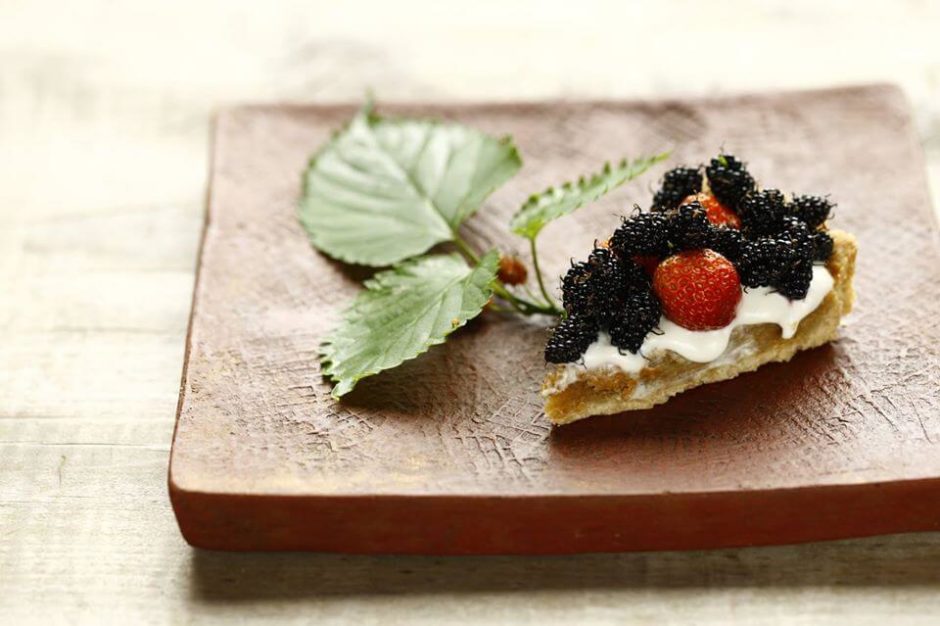
At Satoyama Jujo, we bake the cake we welcome you with and the biscuits and cupcakes you’ll find in your room. We make all our desserts ourselves too, and what we serve changes almost every day.
Last week and this week, there’s been a bumper crop of mulberries on the hillside behind us. We’ve been out picking the berries – wonderfully sweet and full of flavour – and we’ve made them into a tart.
They’re wild berries, after all: they all ripen at once and fall at once. So this will probably be the last week for mulberry tart. Next week we’ll serve a different dessert.
By the way, we never use jōhakutō, the soft, refined white sugar common in Japan, in our cooking or our desserts. You won’t find any in our kitchen, nor will you find artificial flavour enhancers or chemically produced oils.
For sweetness, we use beet sugar, wasanbon (a fine traditional Japanese cane sugar) or mirin (a sweet rice wine used in cooking). We use only pressed oils, even though they cost more.
‘I ate so much, but it didn’t sit at all heavily on my stomach.’
‘I didn’t feel at all puffy the next morning.’
We hear comments like these a lot. It’s down to the quality of the ingredients we use.
Rather than go on about how good the food is for you or how good it tastes, we’d be happy if you listened to your own body. It tells you the truth, after all.
*This information was current at the time of publication.