


Even one night is enough to give you a taste of the wild country around us. But to enjoy Oze itself, two nights and three days are best. Lake Okutadami, a favourite haunt of the writer Takeshi Kaiko, is home to char more than 60 centimetres long. In recent years, word has spread of the clouds that cascade over Shiori Pass and the snow that lies year-round at Naka-Arasawa. There’s plenty to discover around Oze Jujo. Now, set out on an adventure of your own.
Hiking
Stay at least two nights and make time for Oze
Okutadami Dam helped power Japan’s rapid economic growth, yet Ginzan-daira itself had no mains electricity until the 1970s. Takeshi Kaiko spent three months at Murasugi working out the shape of his novel Darkness in Summer. He chose a place with so few conveniences precisely because the country around it had captivated him. Today Ginzan-daira has both electricity and fibre broadband, but thanks to the association Kaiko founded to protect Okutadami’s fish, the rivers and the wilderness around them remain much as he knew them. The best way to get to know this country is to take your time and walk. A stroll around the former Murasugi, now 10 Stories Hotel OZE (Oze Jujo), is enough to bring you into the midst of it. But since you’ve come this far, we hope you’ll go on to Oze. Oze lies upstream of Lake Okutadami, where the Tadami River draws its waters from a vast area. The Uonuma–Oze route from Oze Jujo follows those waters towards their source, and getting there is an adventure in itself. Cross Lake Okutadami by sightseeing boat to Ozeguchi, then take the bus that winds through old-growth forest to Numayama Pass. From the pass it’s a little over an hour’s walk to Lake Ozenuma, even at an easy pace. If you take your own car, it’s an hour and 20 minutes along an exhilarating mountain road from Oze Jujo to Oze Miike. Private cars are not allowed beyond Miike; change there for the 20-minute bus ride. The boat-and-bus service on the Uonuma–Oze route makes just two round trips a day, one in the morning and one in the evening. We recommend at least two consecutive nights at Oze Jujo.
Cycling
Mountain country by bicycle
Routes around Oze Jujo range from almost level circuits for beginners to demanding hill climbs. Even the easiest take you into unspoilt country. Ride through old-growth forest and listen to the mountain streams: you can feel your senses sharpen. With a pedal-assist bike you might even make for Shiori Pass, famous for its cascading clouds. There are rare plants to see at close quarters and birds with lovely, clear calls; sometimes a hare, a weasel or a raccoon dog appears right in front of you. In spring, ride with snowy peaks and fresh green leaves in view; in autumn, the trees wrap you in crimson.
Cycle hire at Oze Jujo
Mountain bike: ¥3,300 per bike for two hours, including a helmet.
Pedal-assist electric bike: ¥3,300 per bike for two hours, including a helmet.
Liability and personal accident insurance are not included. Please arrange your own cover.
Mountaineering
A special trail up Hiragatake, one of Japan’s 100 Famous Mountains
You can climb Echigo-Komagatake, one of Japan’s 100 Famous Mountains, or Arasawa, one of the 200 Famous Mountains, as a day trip. There’s also something special for Oze Jujo guests alone: a trail up Hiragatake. The length of the usual route makes this one of the toughest climbs among the hundred. The standard walking time is at least 11 hours there and back. There are no mountain huts or campsites along the way, so you must pick a fine day and set off before dawn. There is, however, another trail: the ‘Prince’s Route’, which the present Emperor climbed when he was Crown Prince. By this route it’s just under four hours to the summit and just under seven for the round trip. There’s a locked gate on the forest road leading to the Prince’s Route. The key is held by the 58 Association, which owns the mountains here as far as the eye can see. Having taken over a local guesthouse, Oze Jujo is itself a member and holds a key. We plan to run special trips up Hiragatake several times a year. Keep an eye on our website and social media, where we’ll announce when you can book.
All three mountains require proper mountaineering equipment. Walking boots, waterproofs, warm layers and food to eat on the move are essential. Arasawa is strictly for advanced climbers: its difficult sections fitted with fixed chains are on a par with the notorious kiretto, or deep notches in the ridges, of the Northern Japanese Alps. Beginners must not attempt this mountain.
Water activities
Stand-up paddleboarding and kayaking on Lake Okutadami
From summer into autumn you can paddleboard or kayak on Lake Okutadami. Oze Jujo has boards for hire, but the lake is deep and the water cold: it is dangerous for a beginner to set out alone. If you’re inexperienced, please join an instructor-led tour. The listed rate for a private instructor for a full day is ¥00,000. Please enquire directly with the guides below.
Equipment hire at Oze Jujo
Paddleboard: ¥3,300 per board for four hours, including a paddle and life jacket.
Wetsuit: ¥1,100 for four hours.
Liability and personal accident insurance are not included. Please arrange your own cover.
The water is cold. You must wear both a wetsuit and a life jacket.
Paddleboarding instructors
〇〇〇〇〇〇〇〇〇〇〇〇
〇〇〇〇〇〇〇〇〇〇〇〇〇〇
Watch the natural world from a sightseeing boat
If paddleboarding or kayaking sounds a little daunting, why not take in the mountain scenery from one of Lake Okutadami’s sightseeing boats? The Okutadami circuit and the Ozeguchi route leave from Okutadami Dam, a ten-minute drive from Oze Jujo. When the leaves turn, from early October to early November, the Ginzan-daira route also runs in both directions between the landing at Ginzan-daira and the dam. Each boat trip takes about 40 minutes. Fresh leaves against lingering snow in May and June, or mountainsides in their autumn colours in October and November: the sight really does take your breath away.
Okutadami circuit (20 May–8 November)
40 minutes; adults ¥1,200, children ¥600
Ginzan-daira route (8 October–6 November)
40 minutes each way; adults ¥1,500 (¥2,700 return), children ¥750 (¥1,350 return)
Ozeguchi route (1 June–15 October; advance booking required)
40 minutes each way; adults ¥1,500 (¥2,700 return), children ¥750 (¥1,350 return)
Lake Okutadami sightseeing boats
http://okutadami.co.jp/boat/
Stargazing
The Milky Way, a distinct white band of cloud
Apart from the guesthouses, there are hardly any buildings around Ginzan-daira. Mountains close it in on every side, and on a moonless night the Milky Way stands out clearly: look for the cloud-like band of white overhead. With binoculars you can even pick out the Andromeda Galaxy and the Orion Nebula. If your visit coincides with a meteor shower, shooting stars streak in every direction. For a good view of the Milky Way, Andromeda and the Orion Nebula, choose a night close to the new moon.
To borrow at Oze Jujo
Picnic mat: free. Lie back and watch the stars.
Rotating star chart: free
LED lantern: free
Nights are cold. Be sure to bring warm layers, such as a fleece to wear under waterproofs.
Moon phases and meteor shower calendars
Tenki to Kurasu
https://tenkura.n-kishou.co.jp/tk/star/star_cal.html
National Astronomical Observatory of Japan
https://www.nao.ac.jp/astro/basic/major-meteor-shower.html
Before dawn: the cloud cascade at Shiori Pass
In recent years, as word of the cloud cascade at Shiori Pass has spread, amateur photographers have come from all over Japan to see it. Before dawn, the sea of cloud over Ginzan-daira spills across the ridge: a sight at once powerful and otherworldly. The pass, at 1,065 metres, is 7.2 km from Oze Jujo along National Route 352, about 15 minutes by car. From mid-September to the end of October, the best season for the cloud cascade and the autumn colours, buses to the pass leave from right outside Oze Jujo every 20–40 minutes from 04:00 on Saturdays, Sundays and public holidays. The clouds are at their most beautiful in the hour leading up to sunrise. By about half an hour after sunrise, they’re gone.
Uonuma Waterfall Cloud Shuttle Bus: 2023 service information
https://www.iine-uonuma.jp/202309-16821/
The fare is ¥1,000; guests staying overnight travel free.
Be sure to bring warm layers, such as a fleece to wear under waterproofs.
Fishing
On Lake Okutadami and the mountain streams nearby
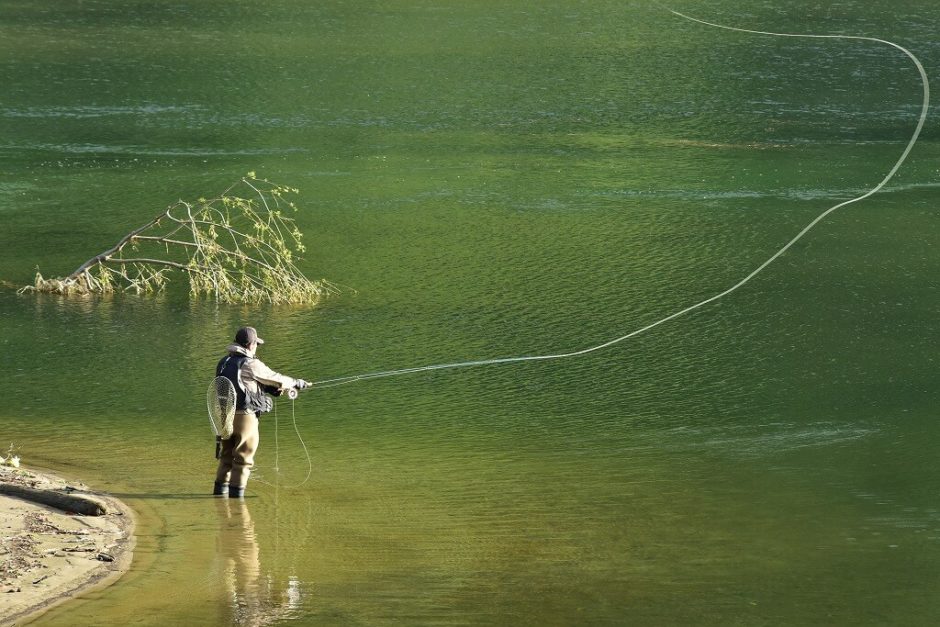
Anglers still land char measuring 60 centimetres or more in Lake Okutadami, also known as Lake Ginzan, where Takeshi Kaiko used to fish. In 1975 Kaiko took the lead in founding the Association for Nurturing Okutadami’s Fish. It secured a complete ban on fishing in the Kitanomata River, which runs just behind Oze Jujo. The char have kept their habitat, and in recent years anglers have been landing even larger fish in the lake. Oze Jujo occupies two renovated guesthouses: Murasugi, where Kaiko stayed, and Hakko next door. For an angler, it might well be a place you dream of staying. Thanks to Kaiko, though, there are plenty of guesthouses and traditional inns around Ginzan-daira and Lake Okutadami that know their fishing. Both Murasugi and Hakko had a following among anglers, but we want our neighbours to thrive alongside us, so at Oze Jujo we’ve decided not to make fishing our main draw. We no longer hire out boats ourselves; instead, we arrange hire through others. We’re a good choice if you fancy casting a line in the morning or evening. If you’re coming especially for the fishing, do consider the inns below as well. On Lake Okutadami, please practise catch and release, as Kaiko advocated.
Okutadami Sanso
https://www.okutadami.jp/wp/fishing/
Kozanso
https://kozanso.jp/fising.html
Snowshoeing
On snowshoes into mountains with no trails
Six metres of snow or more fall at Oze Jujo in winter, and in some years as much as ten. The snow cuts off access from December to mid-April. Once the road reopens in mid-April, you can snowshoe until just after Golden Week, Japan’s run of spring holidays ending in early May. As avalanche activity eases, it’s a good time to explore mountains with no walking trails. Join one of the guided tours and follow the tracks of hares or Japanese serows, the local goat-like mammals. Even a short climb gives you a view you wouldn’t usually see. For the descent, sliding down on your backside saves time and is half the fun. Let yourself be a child again.
Equipment hire at Oze Jujo
Snowshoes and poles: ¥3,300 per set for two hours.
Shell jacket, shell trousers and gloves: ¥5,500 per set for two hours.
Avalanches are less frequent at this time of year, but the entire depth of snow can still slide. If you cannot recognise avalanche terrain, keep to walks on the nearby snowfields and follow staff instructions, or join a guided tour.
Bring mid- or high-cut walking boots. Snowshoe straps can slip off low-cut shoes; you could hurt yourself or lose a snowshoe.
Bring gloves and protective clothing for the cold, such as a waterproof jacket and trousers, a hard-shell jacket and trousers, or skiwear. Gaiters are ideal for keeping snow out of your boots.
Liability and personal accident insurance are not included. Please arrange your own cover.
Snowboarding and skiing
Okutadami Maruyama Ski Resort, ten minutes away by car, is unusual: it closes from mid-January to mid-March because there is so much snow. Its two seasons run from early December to early January and from mid-March to mid-May. In spring you can ski among beech trees coming into leaf. Equipment is available for hire at the resort.
Okutadami Maruyama Ski Resort
http://okutadami.co.jp/ski/
Cuisine
Where civilisation meets the wild
It’s hard to imagine now, but there was once a year-round settlement here in Ginzan-daira, in the Okutadami mountains, where six metres of snow or more cut people off entirely from the villages below. To see them through the long, hard winters, they laid in stores of preserved and fermented foods and hunted bears and other game. Matagi, Japan’s traditional mountain hunters, still hunt here, and some people earn their living gathering edible wild mountain plants. At primitif, Oze Jujo’s restaurant, we draw on that knowledge. Our theme is ‘where civilisation meets the wild’. Rather than serve traditional regional dishes, we bring the latest cooking techniques to those mountain plants, preserves, fermented foods and game. Come and taste what we make with them: flavours you’ll find only here.
See Dining for details
Wildlife watching
Here, we’re in the animals’ territory
An ancient ecosystem survives here in Ginzan-daira, in the Okutadami mountains. Though downstream of Oze, we’re deeper in the mountains here, and one of the great pleasures of the place is the sheer abundance of plant and animal life. It’s not unusual to see hares, weasels, squirrels or raccoon dogs crossing the grounds. Bears are wary and rarely show themselves, but this territory belongs to the animals. Respect the boundary between their world and ours: never feed them or do anything to provoke them. This is the insects’ territory too. One year there may be great numbers of dragonflies; another may bring horseflies or biting blackflies. Moths and shieldbugs have their years too. When insects are this numerous, we can’t keep them all out of the buildings. Please see this, too, as a chance to observe the natural world.
Sauna
We chose the spot with the best view at Oze Jujo for our saunas. Straight ahead are Echigo-Komagatake, one of Japan’s 100 Famous Mountains, and Nakanodake. The Kitanomata runs alongside, its char visible to the naked eye. In front of you a tributary tumbles over a waterfall into the main river. Built of hand-cut cedar logs, the sauna cabins are a tribute to Murasugi Hut. There are two, one for women only and one mixed, both wood-fired. Burning wood in a city can hardly be called sustainable, but here in the mountains our firewood is an entirely sustainable fuel. We use trees brought down by heavy snow or avalanches, and timber from forest thinning. Using this wood helps keep the mountain forests in good condition and provides work in mountain villages. Spring water from Mount Arasawa feeds the small pool we use as a cold plunge. Takeshi Kaiko called the water of Ginzan-daira ‘the very finest’. In his book White Pages he wrote:
On the shore of Lake Ginzan,
water tasted of water,
trees were trees,
and rain was rain.
That same water flows abundantly and continuously through the plunge pool. From the chairs on the wooden deck you can look out at the mountains and the waterfall. Beside the river, facing Echigo-Komagatake, we’ve also built an open-air bath fed directly and continuously from Ginzan-daira hot spring. The water emerges at 42°C and we add no heat, so the bath is 33–37°C in spring and autumn, and only 38–39°C even in summer. That’s on the cool side for a hot bath, but just right for a warm soak after the sauna. Let yourself float as you alternate between warm and cold.
Opening hours: 12:00–18:00. From 12:00 to 15:00, access is restricted to guests staying two or more consecutive nights and day visitors.
Everyone must wear swimwear. Please bring your own or hire it for ¥600.
Day visitors are welcome from 12:00 to 15:00. Day admission: ¥4,400.
The information given here dates from the time of publication.